

EU biodiversity funds squandered on fake rubble walls in Gozo
by Victor Paul Borg
July 2025
Abstract: Rubble walls on the islands of Malta and Gozo are an ecological habitat and protect soil in terraced fields from soil erosion. But instead of using EU rural development funds to rebuild collapsed rubble walls on slopes and sides of valleys, and enhance biodiversity in farmland, the Maltese government spent more than 12 million euros of EU funds to construct walls along roads – many of them main roads connecting villages or leading to bays – that are more infrastructural than agri-environmental, as the funds were intended. Many of these walls are fake rubble walls backed with limestone blocks and concrete, and only clad with roughly hewn stone. Others were built from broken limestone sourced from demolition of buildings by developers. Some even had concrete poured in their core. A journalistic investigation reports on all this, showing that this is not only in breach of regulations on rubble walls in the country – where rubble walls are protected in law – but may also be a misuse of EU funds.
Millions in EU funds designated for enhancement and restoration of ecosystems in farmland were used in Gozo to rebuild stretches of “rubble walls” backed by blocks of limestone and cement, and only superficially clad by unhewn rubble stones, a journalistic investigation can report.
The investigation has also found that these walls do not adhere to the definition and protection afforded to rubble walls in law, and diminish rather than enhance biodiversity.
The funds were granted to the EcoGozo Directorate, which is tasked with steering Gozo towards sustainability and protecting nature. They came from the European Agricultural Fund for Rural Development (EAFRD). The directorate, within the Ministry for Gozo, received three grants: just over €10 million for “Gozo’s valleys”, €2.3 million for Ramla Valley, and €371,000 for Marsalforn Valley.
Each of the funds was for the construction or restoration of rubble walls, awarded under Measure 4.4 – one of four measures under the title of Restoring, Preserving and Enhancing Ecosystems in farmland areas. They were intended to prevent soil erosion.
The project description for the grant of €10 million was for “rehabilitation of Gozo’s valleys to enhance their rain capturing and soil retention capabilities” and the works involved “building and restoring dry stone and rubble walls.”
The walls were mostly built along roads that skirt valleys, some of them being main roads between villages. At least one road was on a plateau – the road that leads towards San Raflu from the fringes of Kercem. Walls along that stretch can hardly be described as having a priority when it comes to soil retention in Gozo as the fields are on a plateau and the level of that road is only marginally lower than the level of fields. In at least another two cases, the fields were at a lower level than the road, and as such there could be neither soil erosion nor “soil retention”.
In a bid to check all the roads, I asked Anthony Camilleri, the director general of the Funds and Programmes Division within the Maltese government, for a list of the locations or roads where this work was taking place. Camilleri twice said he needed more time to reply, but then he never sent me the list despite reminders and the passage of almost two years. I asked him again last month, but my email remained unanswered.
So I used information from notifications of works published by the Planning Authority in recent weeks, sources, press releases, and Facebook posts of the Minister for Gozo, Clint Camilleri, to locate the roads where the walls had been or were being built.
In one of the cases, a source at the Ministry of Gozo told me that the walls along a largely flat stretch of the road from Rabat to Nadur, at Ta’ Xhajma, were also rebuilt from these funds. That information is corroborated by a notification of works requested by the director of EcoGozo in recent weeks, and endorsed or published last week, which now refers to works that were completed around two years ago. In that case, the level of the road is slightly higher than the level of the fields beyond, and as such there is no soil for the walls to retain. Such walls can be more appropriately described as infrastructural improvement – a more aesthetic, newer and higher wall than the one that existed. Similarly, a stretch of the arterial road between Rabat and Xaghra can be more fittingly described as infrastructural work.
When the work neared its completion, two years ago, the Minister for Gozo in a press release boasted that more than 30 kilometres of walls had been built.
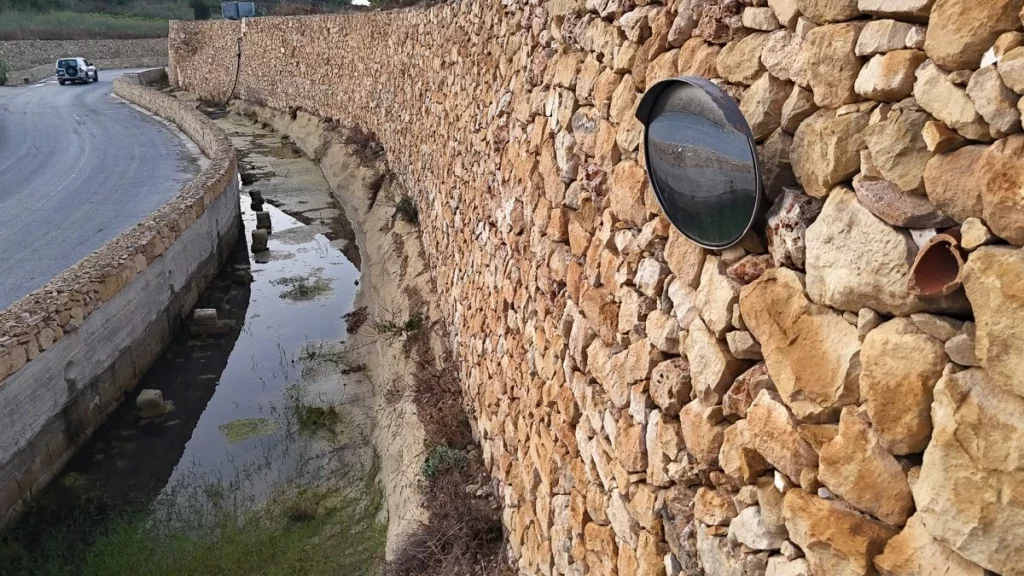
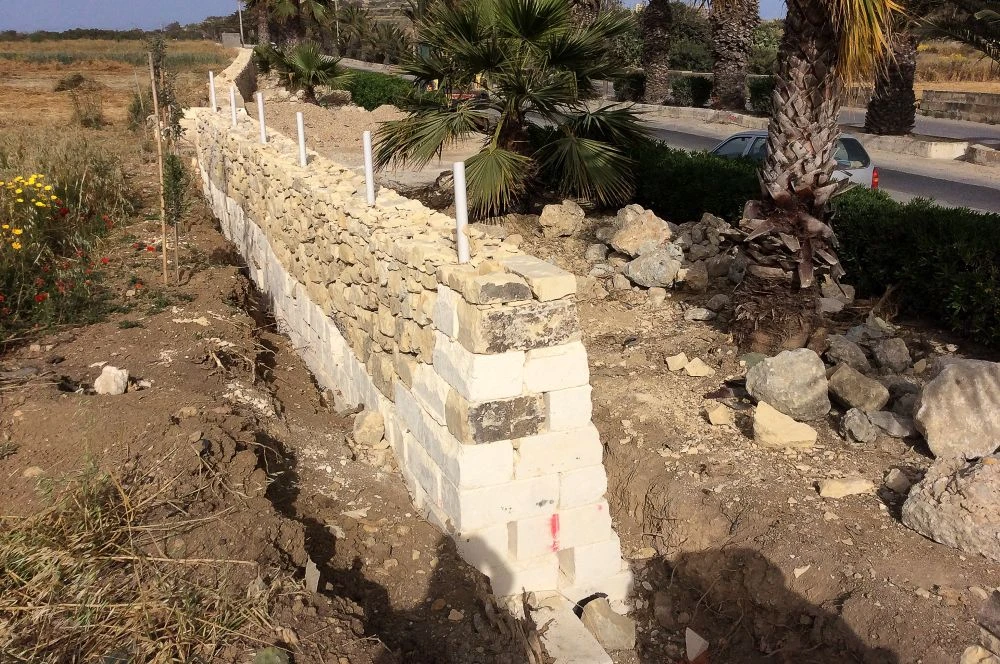
Two years later, many stretches of these walls remain visibly devoid of flora and fauna. In normal rubble walls, with soil filling the cavities of the wall and some moisture remaining within the wall as the surrounding fields bake in summer, various species of flora and fauna find refuge in the wall. Other shrubs grow at the base of the walls, creating micro-habitats and a micro-climate – and a habitat protected in law. But in significant stretches of the walls built with EU funds in Gozo in recent years, little soil, if any, can fill the cavities and the walls remain relatively barren of wildlife. This is because the backing is of cement and blocks of limestone, or cement that has been poured as infill in some areas, or in some other areas walls constructed of broken limestone sourced from building demolitions. (For full description of rubble walls as habitat, see the last section of the article)
At a stretch of 2km at Ramla Valley, funded by €2,234,700 of rural funds for “building and restoration of dry stone and rubble walls” and carried out by the EcoGozo Directorate, the works tore up the valley in breach of planning permit conditions and environmental regulations.
Ramla Valley is one of the strongholds for chaste trees, which are rare in Malta and occur in various valleys in Gozo. The works, which involved excavation by mechanical excavators, destroyed at least two large chaste trees.
This led to the Environment and Resources Authority (ERA) to issue a fine to EcoGozo Directorate that was, according to a source, between €10,000 and €20,000.
The Ministry for Gozo had originally applied for a planning permit for the works in Ramla Valley in 2017, and the Planning Authority initially recommended refusal of the application. This turned into an approval, in 2018, after the project architect, Godwin Sultana, drafted a Comprehensive Method Statement that led ERA to drop its opposition to the works.
The works, according to the method statement, were intended “to repair existing walls which are structurally sound by traditional means in order to maintain its [the wall’s] integrity” and to “replace unsound walls with traditional rubble walls characteristic of the rural environment.”
“The project,” wrote the architect, “seeks only to work within the footprint of the existing walls maintaining existing dimensions.”
The architect wrote that the walls would be “built from different sizes of limestone blocks (tal-Franka or tal-Qawwi), roughly fitted together with minimal clearance between adjacent stones and no use of mortar.”
And “structurally unsound” stretches of walls would be “carefully dismantled”, with the “equipment to be used for this project are [sic] common in nature for minor excavation works, minor concrete works, and masonry works.”
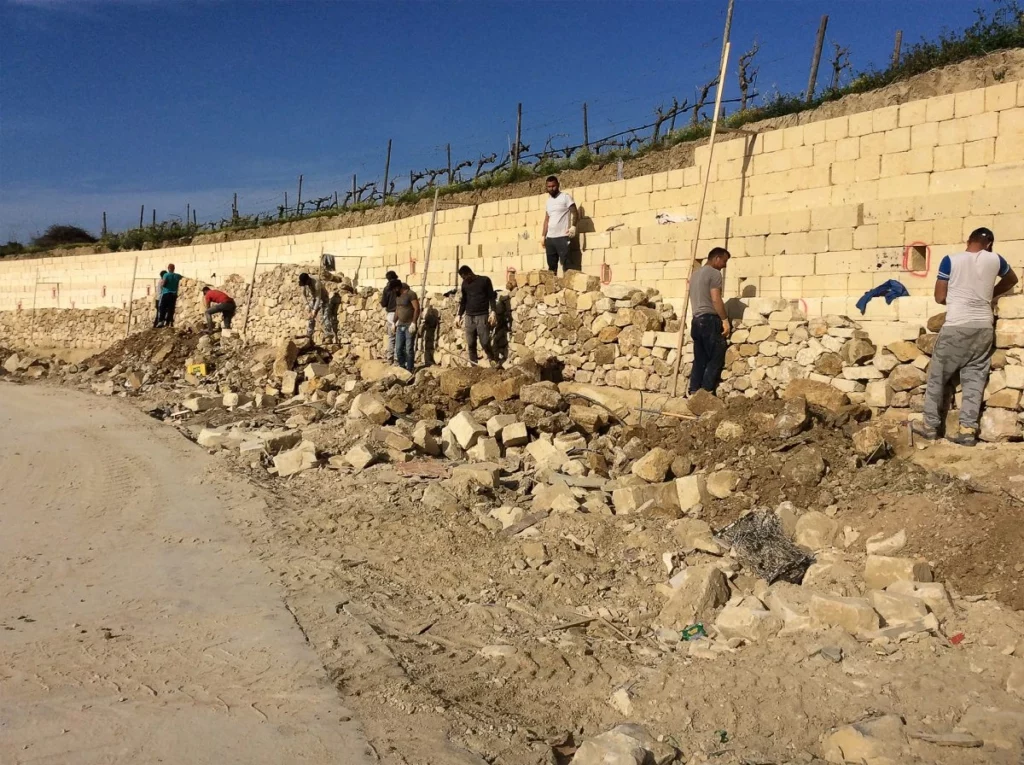
The works were contracted to Little Rock Quarry Limited, whose owners have other companies that are involved in road building and quarrying, as well as property development. The works involved diggers, excavators, trucks and cranes, and they were carried out mostly by labourers from southeast Europe (Albanians, according to a source).
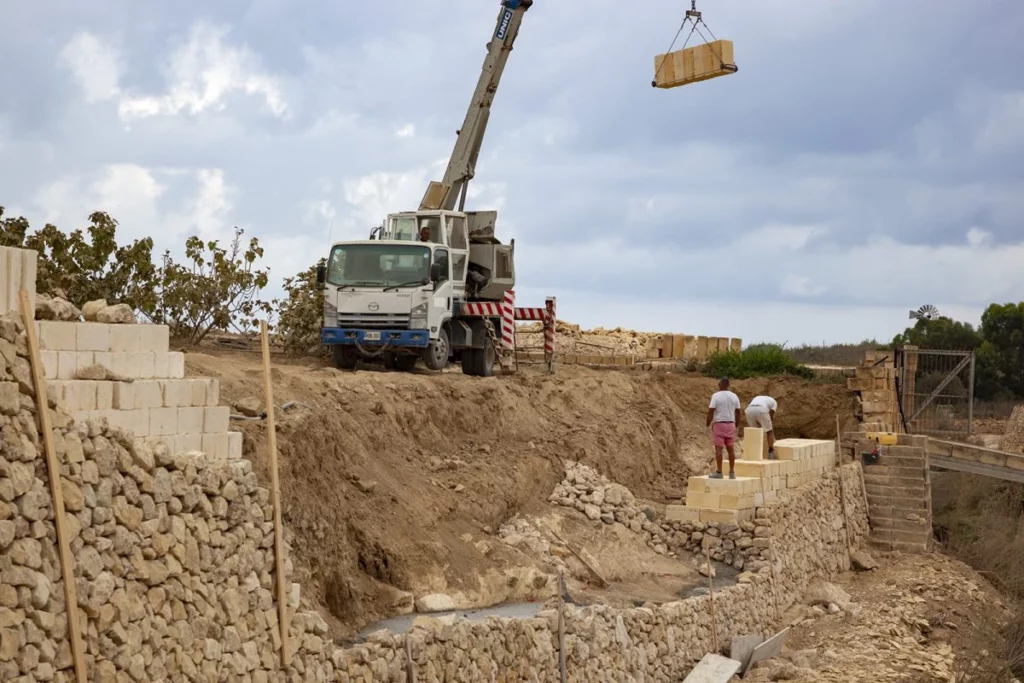
Rather than having works “carefully managed to ensure that disruption to the surrounding areas is avoided,” as promised in the method statement, the existing walls were bulldozed and soil and substrate dug up at the sides of the valleys to make room for thick walls – much thicker than what existed before – built of globigerina blocks of limestone. The rough unhewn ‘rubble’ stones were then set at the outer level, merely as cladding, with cement in between the blocks of limestone and the unhewn stones, presumably to fix or anchor the ‘rubble stone’ cladding.
Works were halted when I sent queries to the Planning Authority and ERA (Environment and Resources Authority). That is when ERA fined EcoGozo – the entity that was formed to protect nature in Gozo. The works then resumed a few months later.
In response to further questions, the Planning Authority claimed that the resumption of work consisted of “remedial works” whose purpose was to “shore up collapsing walls and clear any loose debris from the valley system following this year’s storm.” These urgent works, it said, had to be carried out “to avoid danger to public and the free flow of storm water.”
Works dragged on, and the second wall, between the road and valley, was only completed in recent months.
I asked Anthony Camilleri, director general of the Funds and Programme Division, whether the Managing Authority, the entity within the Maltese government that manages EU funding, would withdraw the funding on the basis that the “rubble walls” were in breach of regulations on rubble walls, in breach of the Planning Authority permit conditions, and – in the view of naturalists I consulted – did more damage than good to biodiversity.
He wrote that EU funding “is possible only when projects being supported are in line with all the pertinent regulatory obligations”, and that the Managing Authority is “liaising with the authorities responsible for planning and environment obligations”.
But he declined to reply definitively to a question on whether funding for the Ramla Valley works had been withdrawn.
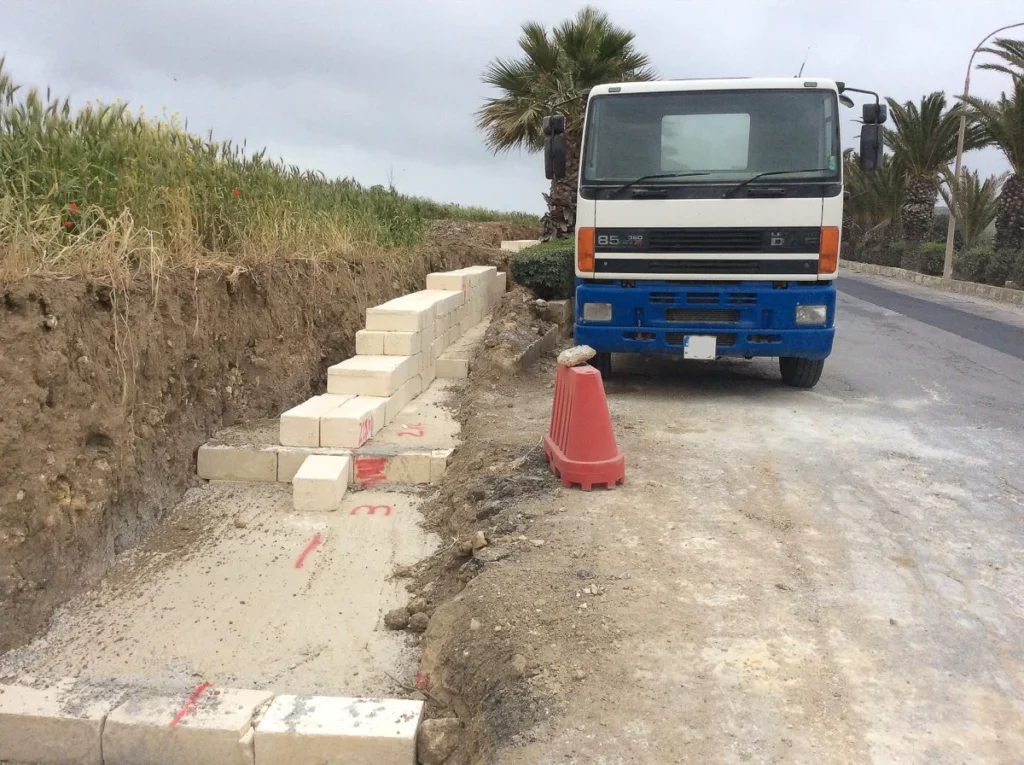
In one of his Facebook posts about the construction of the EU-funded rubble walls, Gozo Minister Clint Camilleri wrote about “strengthening traditional infrastructure for soil retention” as well as the “added value” of attractive rural roads that “complements the natural beauty of some of the most attractive countryside walks.”
In law – specifically, the Rubble Walls and Rural Structures (Conservation and Management) Regulations of 1998 – rubble walls are declared as “protected” due to “their historical and architectural importance, their exceptional beauty, their affording a habitat for flora and fauna, and their vital importance in the conservation of the soil and of water.”
The law defines rubble walls as “a dry stone wall, built in loose unhewn or rough-dressed stones which stands by gravity and friction without the use of mortar.”
That means that significant stretches of the rubble walls built with funding from the EU’s rural development funds, which has the overarching aim of enhancing biodiversity, were not built in conformity with the law.
Aside from the walls in Ramla Valley mentioned above, I found other stretches of walls that were backed by cement or globigerina limestone. I did not manage to visit all walls during the construction stage, and as such it is not possible to be sure of all the ones that were backed with stones or cement, and only clad with unhewn stones.
I did find stretches entirely built from rubble stones, and it was not possible for me to estimate the proportion of walls that were backed by a layer of cement and globigerina limestone. However, I also saw other things: in two areas in which the walls were built entirely from rubble – or unhewn stone – cement was poured into the core of the walls to give the stones anchorage, and the wall strength and durability. This is also in breach of law, and such walls end up having cement – not soil – fill some or most of their cavities, thus impeding the formation of micro-habitats within the wall.
In another stretch, at the west of Gozo, a significant amount of the material that was being used to construct the ‘rubble walls’ was demolition waste. In contrast, traditional rubble walls are made of a mixture of stones.
In fields, such stones tend to be found mixed with the soil – and mostly stones of upper coralline limestone – and the rubble wall would serve the functions of having the soil cleaned from stones, dividing land-holdings and, on slopes, preventing soil erosion.
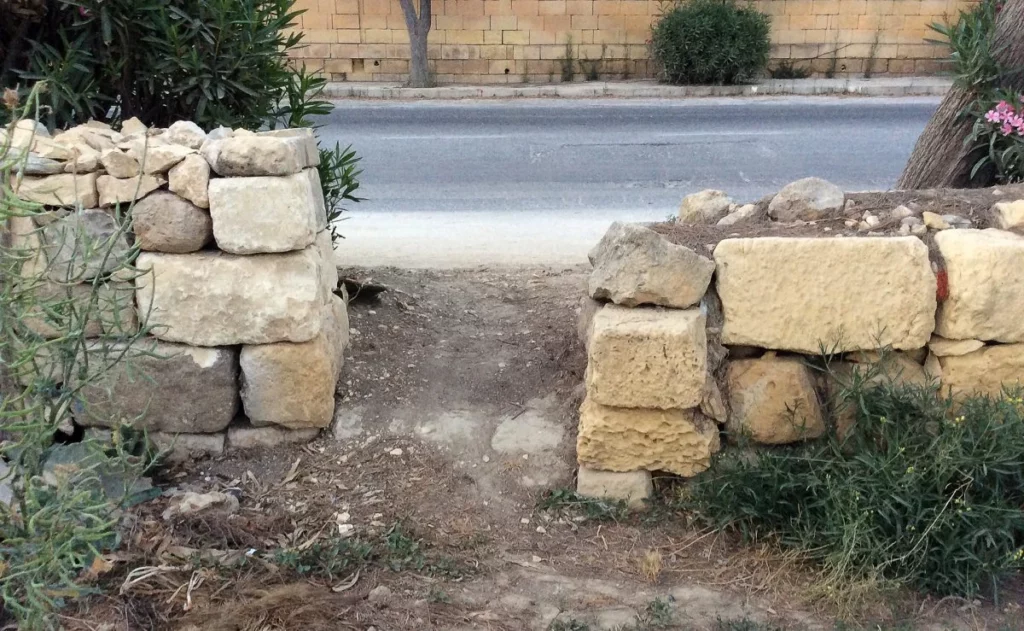
I also saw a few stretches of walls apparently funded by the EU’s rural funds to be constructed mostly of roughly broken globigerina limestone. The provenance of such limestone is demolitions of houses and buildings, with limestone blocks then further broken before being used to construct the EcoGozo’s “rubble walls.”
The use of such limestone reached its greatest prevalence at Ta’ Xhajma, part of the road between Rabat and Nadur. Although it is not possible to definitively ascertain that this stretch was funded by the same €10 million grant of EU rural development funds, a source told me it was part of that project. And the director of EcoGozo also formally notified the Planning Authority of such works in a process called Development Notification; the Planning Authority approved the notification earlier this month – two years after the walls were actually built.
The grant of €10 million (precisely it was €10,091,000) as well as the separate grant for €2.2 million for building or restoring rubble walls awarded to the Ministry for Gozo, were by far the largest grants awarded under Measure 4.4 in the 2014-2020 allocation of rural development funds.
The third largest grant, of over €700,000, was awarded to the Ministry for the Environment for the restoration and construction of rubble walls at Wied Ghajn Rihana.
All the rest were grants of less than €150,000 – this was the cap for individual landholders – and a significant number of grants were awarded to Local Councils, also for the construction of rubble walls along rural streets.
Only a small number of grants were awarded to farmers in Gozo. The largest individual recipient in Gozo was Daniel Refalo, of DTX Holdings, a developer who partners with Joseph Portelli and the Agius brothers in numerous property developments in Gozo and Malta.
Refalo got two grants, one of €150,000 to construct rubble walls and the second of €149,438, granted as “support for investments in agricultural holdings.” Refalo has planted trees and vines, and constructed rubble walls, on terraced fields at a hillside that cover a relatively large area.
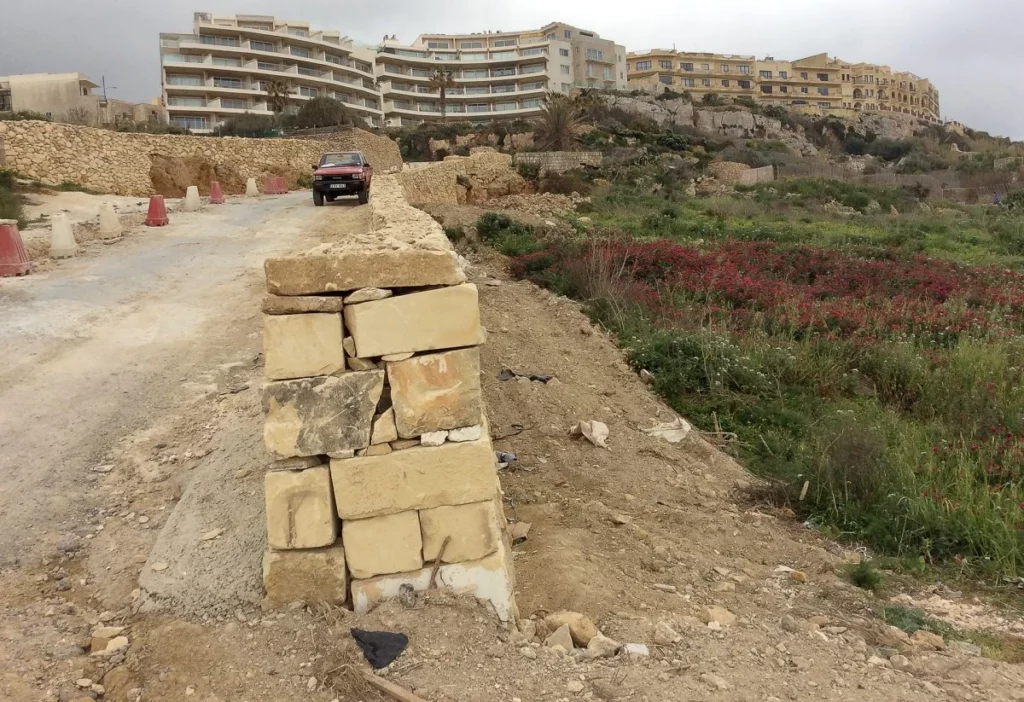
In most hillsides in Gozo, rubble walls along terraced fields are mostly in a crumbled or collapsed state.
I spoke to various farmers about the rural development funds to gauge their interest, and all of them told me they were not aware that, as individual farmers or landholders, they could procure funds to restore rubble walls in their fields.
In this sense, with farmers not widely aware of these funds and rubble walls throughout Gozo’s hillsides increasingly in a collapsed state, the allocation of millions to the Ministry for Gozo for constructing infrastructural walls along roads – some of them rubble walls in appearance only, fake rubble walls – represents a lost opportunity to tackle soil loss on Gozo’s hillsides.
Properly built rubble walls are a habitat for flora and fauna, and they can serve as a refuge for wildlife in intensively cultivated fields. The classical construction method for standalone walls is to have two layers of stones and then an infill of smaller stones – this was described in the book by architect Elizabeth Ellul in 2005, titled Il-Ħitan tas-Sejjieħ.
Over time cavities within the wall then partly fill with soil and certain plants grow out of such cavities. These are predominantly capers, snapdragon, spiny asparagus and wild alyssum. Others include maidenhair fern and Maltese salt-tree – the latter in Gozo particularly, where it grows inland more widely than in Malta. A range of grasses and flowering plants grow on certain rubble walls, as does lichen and moss in winter.
Animals that use rubble walls as home include geckos, ocellated skin, lizards, and snails. Ants also burrow their nests or colonies in the soil in the cavities, even penetrating into the profile of the soil beyond the wall.
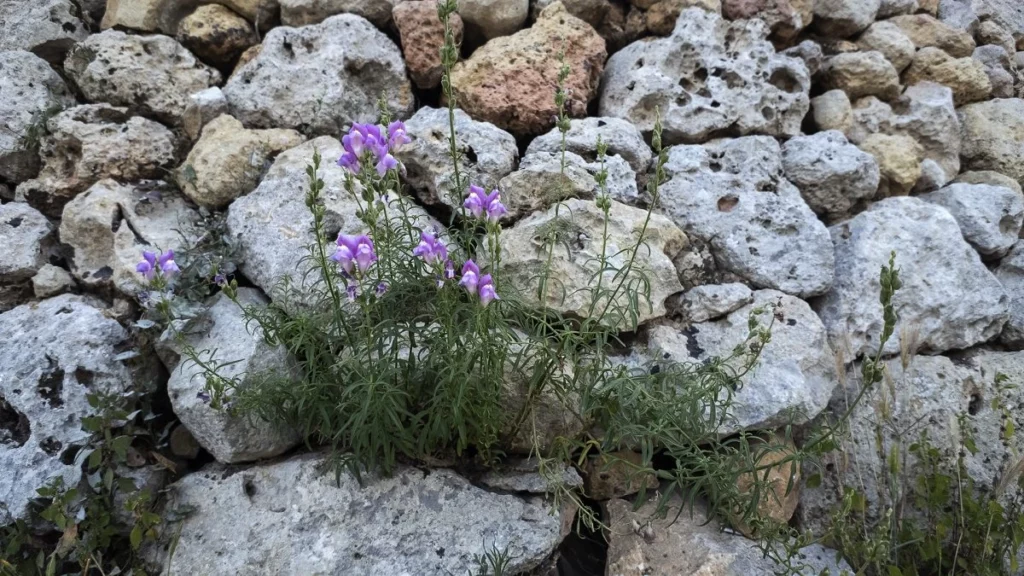
The ecological activity within the walls by animals and plants leads to accumulation of organic matter and detritus, and this in turn attracts other insects. The insects then attract spiders that hunt within the cavities.
The soil in cavities in rubble walls as well as the stones deep down the profile of the wall also remain moister than the open fields on either side of the wall in summer. This creates conditions of micro habitats and micro climate, which then has an impact also beyond the wall. For example, a secondary range of plants grow at the foot of the walls, the roots taking advantage of the rich soil conditions, including moisture retention, of the soil at the base of the walls. These in turn attract other insects and animals and birds.
Walls along terraced fields on slopes, particularly in Gozo, normally consist of one layer of stones. Soil then sets within the cavities, strengthening and anchoring the wall, and allowing a greater range of plants to take root. Although such walls do not retain moisture of the thicker standalone walls described above, they often form strips of interconnected natural habitat between fields.
These processes are not possible in rubble walls in which unhewn, broken rock is backed by a layer of cement and/or globigerina limestone, and hence significant or substantial stretches of the walls built by the Ministry for Gozo’s EcoGozo Directorate with the use of EU’s rural funds do not achieve the effect of biodiversity restoration and enhancement intended in the funding programme.