
📸newsbook
Is this the Christmas Spirit?
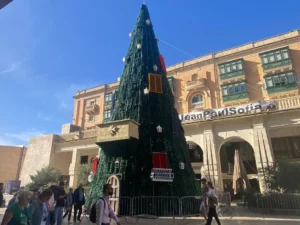
To justify the tree that was erected in front of parliament, there are those who claimed that its decoration was inspired by a poem by Anton Buttigieg. Their hope and ours is only that someone in the festive season will begin to reason in a humane and humanitarian way. This poet, who was also a politician and thinker, is speaking about himself while observing a man, Majsi, who used to come every day to light up the street lamps when, as the sun sets, the light begins to fade. The poet compares the fading light to his life that has come to an end. He says that the action of lighting up the lamps inspires him and as the light alleviates the sadness of the night, the poem, which he sees climbing Majsi\’s ladder, turns on a light of hope: \”which alleviates the sadness a little, until the last remnant of my life dies\”.
A gentle poem, in soft language, about a man preparing himself for death. Its sweet tone has been completely disrespected and betrayed by the vulgarity and ugliness of that monstrous tree that confronts you as you enter Valletta, along with those other equally ugly planters that are supposed to beautify the entrance to our capital, but are nothing more than a means to decrease the space in case of protests. It is obvious that if those who thought of this tree have at least read the poem, they did not understand anything.
But the theme of hope is a theme that is truly linked to Christmas. And when I think of this theme, I cannot stop thinking about those who have little hope left. For example, all those who have been robbed by the cruelty of others: the seriously ill with cancer or other illnesses, those who have severe disabilities, those who are sleeping in garages, or on the street. And I cannot help but think of those poor men from Ethiopia, who after being here for so many years, contribute to our economy, who have never done any harm to the Maltese, rather they have given their work to Maltese society, and now are unjustly in prison waiting for our government to take them back to their country, back to the poverty and war they fled from. These people are so honest that even their employers had the courage to speak up for them.
Perhaps it would be appropriate to place the faces of these victims on those windows of that ugly tree, so that we can remember the horror of the suffering and the hopelessness of people who are in the risk of being sent to their death. But this time there is no Majsi to bring them a ray of hope. Their hope and ours is only that someone, in this period, will begin to reason in a humane and humanitarian way.