
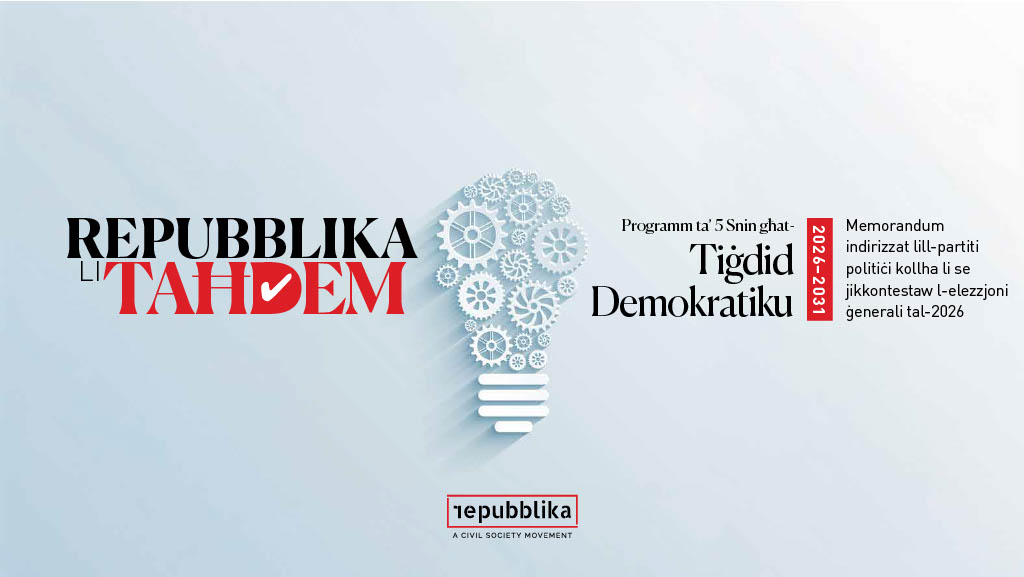


Repubblika today published A Republic That Works, a draft five-year programme for democratic renewal covering the period 2026–2031. The document is being released for public consultation, with citizens invited to submit feedback over the next six weeks before a final version is formally presented to all political parties contesting the 2026 general election.
Speaking on the eve of Republic Day, Repubblika said the initiative responds to a prolonged erosion of public trust in institutions, repeated failures to enforce the rule of law, political interference in oversight bodies, sustained pressure on journalism, and the social and environmental consequences of weak governance. While Malta’s constitutional history and democratic traditions remain a source of pride, the organisation said they are not self-sustaining and require deliberate renewal.
Repubblika stressed that the memorandum is neither a party manifesto nor a finished blueprint. Instead, it is intended as a shared national framework, setting out practical reforms that could be implemented by any government committed to democratic integrity. The proposals are written at the level of concrete institutional change rather than abstract principle, and are designed to be achievable within a single five-year parliamentary term.
The document brings together years of evidence and experience, drawing on the findings of the Daphne Caruana Galizia public inquiry, recommendations issued by European and international oversight bodies, unfulfilled commitments made during previous electoral cycles, and the lived consequences of governance failures for individuals and communities. Repubblika said the memorandum reflects not ideology but accumulated lessons about what happens when institutions are left vulnerable to political capture.
At its core, A Republic That Works is organised around six thematic pillars addressing how power is held and constrained, how corruption and abuse of authority are investigated and punished, how citizens and journalists hold decision-makers to account, how communities exercise real power at local level, how the public interest is protected against private capture, and how human rights and equality are enforced in practice. Together, the proposals aim to restore the balance between authority and accountability that is essential to a functioning republic.
Repubblika emphasised that the programme is modular rather than prescriptive. The reforms can be adopted in phases and sequenced over time, allowing governments to prioritise while remaining fiscally responsible. Many of the measures, the organisation noted, do not depend on increased public spending but on political will, legal reform and the redirection of existing resources. Others would generate long-term savings by reducing corruption, waste and litigation.
The organisation is now inviting members of the public to engage critically with the draft, whether by proposing refinements, suggesting additional reforms, or explaining where they disagree with the approach taken. Repubblika said it expects disagreement and sees it as a necessary part of democratic deliberation rather than a weakness of the process.
Following the consultation period, the memorandum will be revised and formally submitted to political parties, who will be asked to state which reforms they commit to pursuing. Repubblika said the document is intended not only to inform electoral debate but also to serve as a benchmark for accountability during the next legislature.
“A republic is not preserved by anniversaries or ceremonies alone,” Repubblika said. “It is sustained by institutions that work, by laws that are enforced, and by a shared commitment to protect human dignity. This consultation is an invitation to help shape that future.”
12.12.2025
