
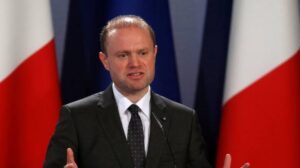
Joseph Muscat should be ashamed of himself. His performance today shows the sheer audacity of a man who, of all people, presumes to lecture others on how the rule of law should be upheld, after doing so much to trample all over it.
Today, Joseph Muscat tried to use Yorgen Fenech’s acquittal to undermine the findings of the Public Inquiry into the assassination of Daphne Caruana Galizia. We will not allow him to rewrite history.
Repubblika respects the constitutional role of jurors and the authority of the Court. The verdict has the force of law, even though we disagree with it. But respect for the rule of law does not require society to remain silent in the face of a verdict that shocked and hurt so many people. Nor does it turn into a “mob” a family still seeking justice for their mother, journalists who fear for their safety, or citizens and civil society organisations demanding accountability and reform.
Joseph Muscat is deceitfully lumping together anger at the verdict, criticism of it, and the different reactions to it in an attempt to discredit public dissent as a threat to the rule of law. We reject his vile premise.
And he is trying to use the verdict in someone else’s trial to challenge the judgment that found him responsible for his own failings five years ago.
The jurors had to decide whether the prosecution had proved beyond reasonable doubt the criminal charges against Yorgen Fenech.
The Public Inquiry had a different question before it: what responsibility did the State bear for the conditions in which a journalist could be murdered and for its failure to protect her?
Yorgen Fenech’s acquittal does not erase the answer to that question.
The Inquiry identified Joseph Muscat’s responsibility for his decision not to take action against Keith Schembri and Konrad Mizzi after the Panama Papers and to keep them in office even after the revelations about 17 Black. It found that those decisions strengthened the culture of impunity in which the relationships between political administrators and big business figures, about which Daphne wrote, were operating. It found that elements of organised crime relied on that impunity and that it “certainly facilitated the assassination”.
As for Muscat’s continued protection of Keith Schembri, the Inquiry described his conduct as “unacceptable” and “condemnable”, and said it bordered on a serious failure and abuse in the exercise of his functions as head of government and guarantor of good governance.
These are not conclusions that depend on whether Yorgen Fenech is found guilty. They depend on what Joseph Muscat did as Prime Minister. Joseph Muscat says he accepts the Inquiry’s conclusions. Then he must accept these too. If he wants “soul searching”, he can start with them.
Joseph Muscat also says that proximity between government and big business is not a problem unless there is abuse. Well, obviously. The Inquiry did not condemn him for meeting businesspeople. It condemned what he did when the Panama Papers and 17 Black exposed serious allegations concerning people at the highest levels of his government. Instead of acting, he protected them.
The Inquiry found that the consequences of those decisions were far more serious than a mere political mistake.
Today, Joseph Muscat is demanding “soul searching” over an Inquiry that found him responsible. He is criticising a member of the Board of Inquiry when the entire Board unanimously found Muscat’s conduct unacceptable and condemnable. And he is trying to use a verdict concerning another person’s criminal responsibility to weaken findings concerning his own political and institutional responsibility.
The jury’s verdict does not erase the Panama Papers. It does not erase 17 Black. It does not erase what was revealed about Electrogas. It does not erase the State’s failure to protect Daphne. And it does not erase the findings of the Public Inquiry concerning Joseph Muscat and the government he led.
Joseph Muscat has no right to rewrite history.
The victim in the story in which he is a protagonist is not Joseph Muscat. It was Daphne Caruana Galizia who was murdered. For almost nine years, her family has carried that loss and fought so that our country might learn from the failures that allowed a journalist to be killed for doing her job.
Joseph Muscat was Prime Minister when the State failed to protect her. He was Prime Minister when Keith Schembri and Konrad Mizzi were caught up in the Panama Papers. He was Prime Minister when he chose to keep them in office. He was Prime Minister when the 17 Black story broke. And the Public Inquiry found that his decisions strengthened a culture of impunity that facilitated the assassination.
After all that, he is in no position to present himself as the victim or as Malta’s teacher on the rule of law.
Yorgen Fenech was acquitted of the charges against him.
Joseph Muscat has not been absolved of his responsibility.
09.09.2026